
Healthcare supply chain leaders are under increasing pressure to do more than manage inventory. They are being asked to reduce delays, improve accountability, support clinical workflows, and provide the visibility needed to make better operational decisions across the hospital.
At AHRMM26, July 26-28 in San Antonio, Texas, ID Integration will be showcasing how hospitals are using passive RFID visibility solutions to create certainty at the workflow moments that matter most.
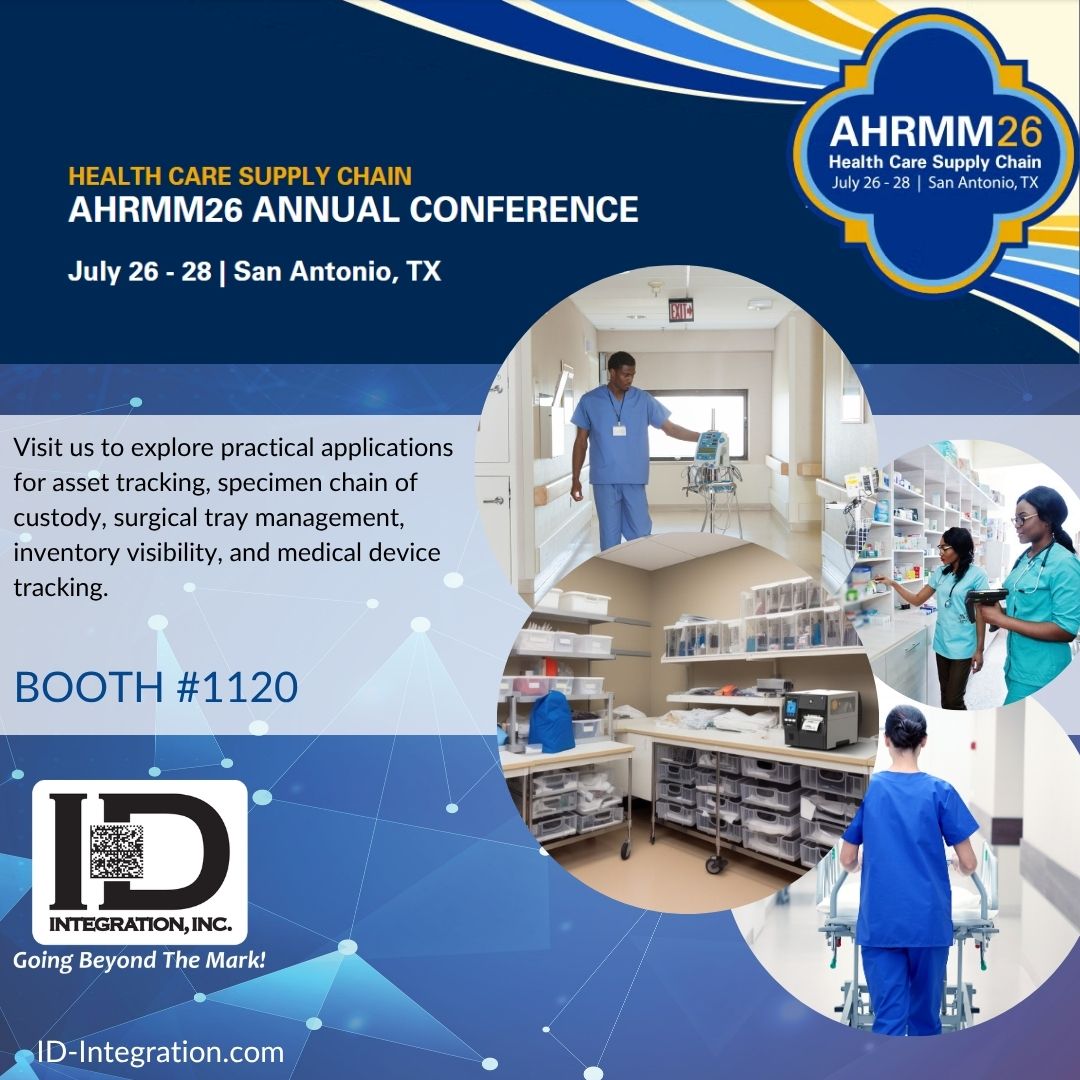
Visit us in Booth 1120 to explore practical applications for asset tracking, specimen chain of custody, surgical tray management, inventory visibility, and medical device tracking.
Why Visibility Has Become a Strategic Priority
Healthcare organizations continue to face staffing constraints, increasing supply chain complexity, and growing pressure to improve operational performance without adding resources.
As a result, visibility is no longer viewed as a technology initiative alone. It has become a strategic capability that helps hospitals reduce uncertainty, improve resource utilization, strengthen accountability, and support clinical teams with better operational intelligence.
The most successful organizations are focusing visibility efforts on the operational moments where delays, missing information, and manual processes create measurable consequences.
Visibility Where Operational Risk Exists
Hospitals do not need to track everything everywhere.
They need visibility at the points where missing information creates delays, unnecessary costs, compliance concerns, or patient safety risks.
ID Integration helps healthcare organizations identify those critical workflow moments and deploy technology that captures meaningful events automatically. The result is greater accountability, faster decision-making, and fewer manual processes.
Whether you are managing equipment, specimens, surgical inventory, or clinical supplies, the goal remains the same: ensuring the right item is in the right place at the right time.
Asset Tracking That Improves Utilization
When equipment cannot be located quickly, staff spend valuable time searching while departments often compensate by purchasing or renting additional assets.
RFID-based asset tracking provides rapid inventory capabilities and near real-time visibility into the location and status of critical equipment.
See how hospitals are using RFID to:
- Complete inventories in hours instead of days
- Quickly locate infusion pumps, wheelchairs, specialty beds, and mobile medical equipment
- Reduce unnecessary equipment purchases
- Improve asset utilization across departments
- Support capital planning with better utilization data
The objective is not simply knowing where the equipment is. It is reducing search time, improving utilization, and helping caregivers spend more time focused on patients.
Strengthening the Specimen Chain of Custody
Every specimen represents a diagnosis, a treatment decision, and a patient’s trust.
Yet many healthcare organizations still rely on manual processes and documentation throughout the specimen journey.
At Booth 1120, learn how RFID can create an auditable chain of custody from collection through laboratory receipt by automatically documenting critical handoffs and workflow events.
Discover how healthcare organizations are using visibility solutions to:
- Improve specimen accountability
- Reduce opportunities for labeling and handoff errors
- Support compliance and quality initiatives
- Create documented chain-of-custody records
- Increase confidence in specimen workflows
For many hospitals, specimen tracking has become one of the highest-value applications for workflow visibility.
Surgical Tray Visibility Without Compromising Sterility
Missing trays, incomplete sets, and unnecessary searches create operational challenges that can impact scheduling and staff efficiency.
RFID allows healthcare teams to identify and locate surgical trays without opening wrapped sets or breaking sterile barriers.
Visit our booth to see how organizations are using RFID to:
- Locate specific trays quickly
- Improve tray readiness for scheduled procedures and support on-time case starts
- Reduce time spent searching for instruments
- Improve accountability throughout sterilization workflows
- Support chain-of-custody documentation for surgical assets
By capturing movement and status automatically, hospitals gain visibility without adding steps for sterile processing teams.
Inventory Visibility and Recall Readiness
Managing high-value supplies and critical inventory requires more than periodic counting.
RFID enables healthcare organizations to automate inventory awareness and quickly identify affected products when recalls occur.
See how hospitals are improving supply chain operations through:
- Automated inventory visibility
- Faster cycle counts
- Expiration monitoring
- Reduced stockout risk
- Improved recall response capabilities
- Better management of high-value inventory
The result is more accurate information and less reliance on manual inventory processes.
Medical Device and Consignment Inventory Tracking
Hospitals and medical device manufacturers share a common challenge: maintaining visibility into implants, loaner kits, and consigned inventory as products move through complex workflows.
ID Integration helps healthcare providers and manufacturers create greater accountability across the entire process.
Learn how RFID supports:
- Loaner tray tracking and visibility
- Implant and device accountability
- Automated receipt and return processes
- Improved inventory reconciliation
- Enhanced utilization reporting
- Reduced manual documentation requirements
The ability to capture movement automatically helps eliminate uncertainty and improve coordination between providers and vendor partners.
From Pilot Projects to Scalable Visibility Programs
Many healthcare organizations have experimented with tracking technologies in isolated departments. The challenge is often not proving that the technology works. The challenge is to create a governance model and operational framework that allows visibility initiatives to scale across the organization.
At AHRMM26, learn how healthcare systems are moving beyond individual pilots and building visibility strategies that support long-term operational goals, integration requirements, and cross-department adoption.
Visibility is becoming an operational infrastructure for modern healthcare organizations.
See What’s Possible at Booth 1120
The healthcare industry continues to invest in technologies that improve efficiency, strengthen accountability, and support better patient outcomes.
At ID Integration, we help organizations move beyond isolated pilots and toward scalable visibility strategies that deliver measurable operational value.
Stop by Booth 1120 to meet our team, explore live demonstrations, and discuss the workflow challenges your organization is working to solve.
Whether your focus is healthcare asset tracking, RFID specimen tracking, surgical tray visibility, hospital inventory management, or medical device accountability, we look forward to showing how event-based visibility can help create greater operational confidence across your healthcare system.